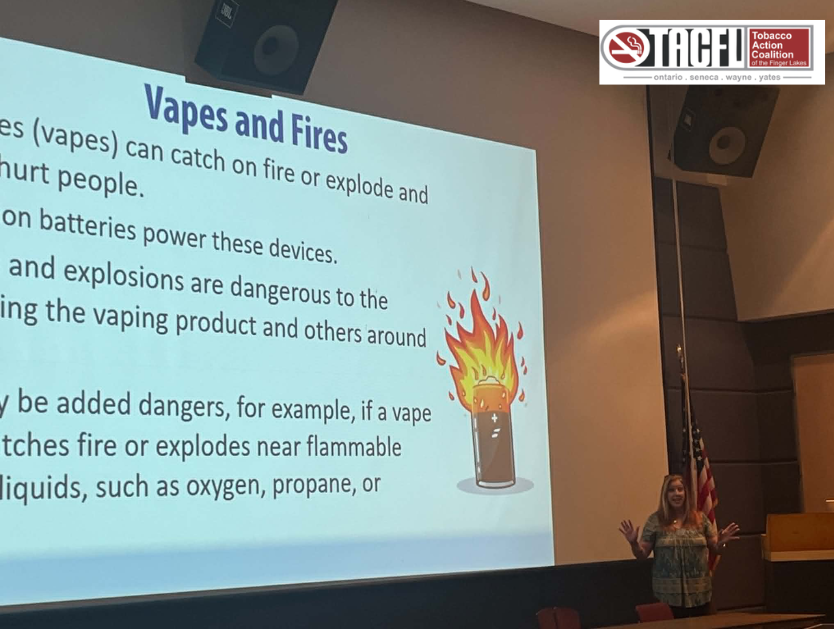
TACFL Team member Tracy Brown-Simmons spoke at a recent Seneca Housing Coalition (website) meeting on the benefits of smoke-free multi-unit housing—and the risks landlords and multi-unit housing complexes face without smoke-free/vape-free policies in place.
(Would you like TACFL to provide a presentation for your group or community? Please reach out! )
Secondhand & Thirdhand Smoke
Secondhand smoke exposure occurs when people breathe in smoke that has been breathed out by those who smoke and use other tobacco products. There is no safe level of exposure to secondhand smoke. Even brief exposure can cause serious health problems.
Secondhand smoke from neighbors can seep through vents, gaps under doors or windows, cracks in walls, floorboards, ventilation systems, plumbing—and even through electrical outlets.
Thirdhand smoke occurs when tobacco smoke leaves residual nicotine and other chemicals (toxic!) on indoor surfaces, skin, fur, and furniture, even after the air has cleared. It can be inhaled, absorbed through skin, or ingested. Thirdhand smoke causes damage to floors, drapery, appliances, ceilings, and painted surfaces.
E-cigarettes (vapes) produce an aerosol by heating a liquid that usually contains nicotine and other harmful chemicals. When the aerosol is exhaled by the user, bystanders can involuntarily breathe in this aerosol.
Scientific evidence indicates that the aerosol emitted by e-cigarettes (vapes) may expose nonusers, including children and infants, to aerosolized nicotine and other potentially harmful substances which are not as safe as clean air.
Source: American Lung Association
FIRE!
“The shape and construction of electronic cigarettes can make them (more likely than other products with lithium-ion batteries) behave like ‘flaming rockets’ when a battery fails.”
E-cigarettes (vapes) can catch on fire or explode and seriously hurt people. Lithium-ion batteries power these devices. Vape fires and explosions are dangerous to the person using the vaping product and others around them.
Source: FDA & U.S. Fire Administration (under FEMA)
Talk to TACFL!
Contact us today! We’re here to help you find answers. Reach out here!

We are hosting a Smoke-Free Movie event with the SHAC of Livingston-Monroe Cos. next month! Please check it out and come to support our mission of reducing the tobacco imagery exposure with our youth population. ... See MoreSee Less
Comment on Facebook
We are so excited!
We are continuing to expand our social media presence! Please go follow us on Twitter to stay connected. Hope to see you there 🙂 ... See MoreSee Less
Comment on Facebook
It has been a while since we have posted, but TACFL would like to spread the love today!
#valentine
#valendinesday
#tobaccocontrol ... See MoreSee Less
Comment on Facebook